以下页面来自赛事官方发布的原题PDF,已完整保存并渲染到本地。
可复制的 PDF 提取文本
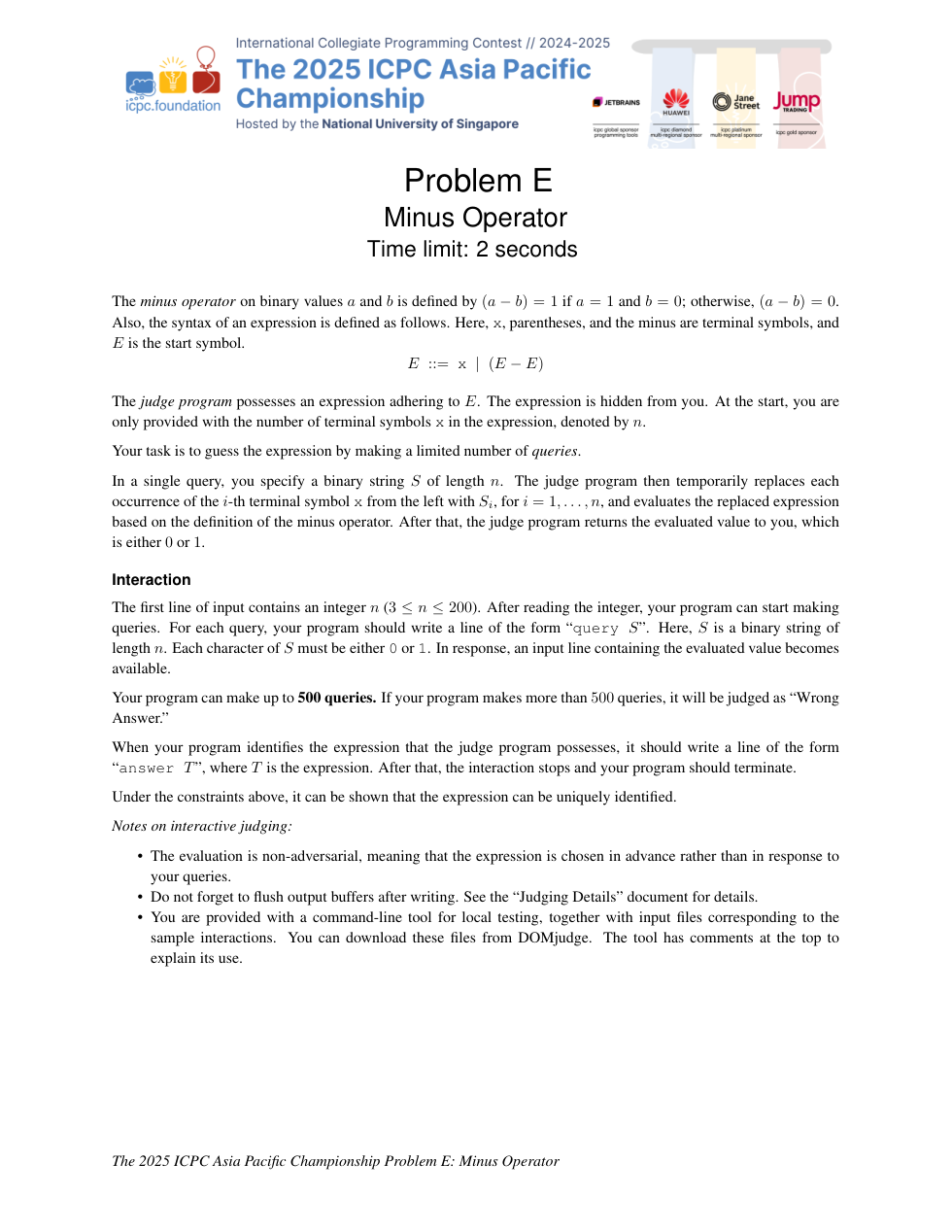
Problem E
                   Minus Operator
                     Time limit: 2 seconds


The minus operator on binary values a and b is defined by (a −b) = 1 if a = 1 and b = 0; otherwise, (a −b) = 0.
Also, the syntax of an expression is defined as follows. Here, x, parentheses, and the minus are terminal symbols, and
E is the start symbol.
                          E ::= x  | (E −E)

The judge program possesses an expression adhering to E. The expression is hidden from you. At the start, you are
only provided with the number of terminal symbols x in the expression, denoted by n.

Your task is to guess the expression by making a limited number of queries.

In a single query, you specify a binary string S of length n. The judge program then temporarily replaces each
occurrence of the i-th terminal symbol x from the left with Si, for i = 1, . . . , n, and evaluates the replaced expression
based on the definition of the minus operator. After that, the judge program returns the evaluated value to you, which
is either 0 or 1.

Interaction

The first line of input contains an integer n (3 ≤n ≤200). After reading the integer, your program can start making
queries. For each query, your program should write a line of the form “query S”. Here, S is a binary string of
length n. Each character of S must be either 0 or 1. In response, an input line containing the evaluated value becomes
available.

Your program can make up to 500 queries. If your program makes more than 500 queries, it will be judged as “Wrong
Answer.”

When your program identifies the expression that the judge program possesses, it should write a line of the form
“answer T”, where T is the expression. After that, the interaction stops and your program should terminate.

Under the constraints above, it can be shown that the expression can be uniquely identified.

Notes on interactive judging:

     • The evaluation is non-adversarial, meaning that the expression is chosen in advance rather than in response to
     your queries.
     • Do not forget to flush output buffers after writing. See the “Judging Details” document for details.
     • You are provided with a command-line tool for local testing, together with input files corresponding to the
     sample interactions. You can download these files from DOMjudge. The tool has comments at the top to
      explain its use.


The 2025 ICPC Asia Pacific Championship Problem E: Minus Operator

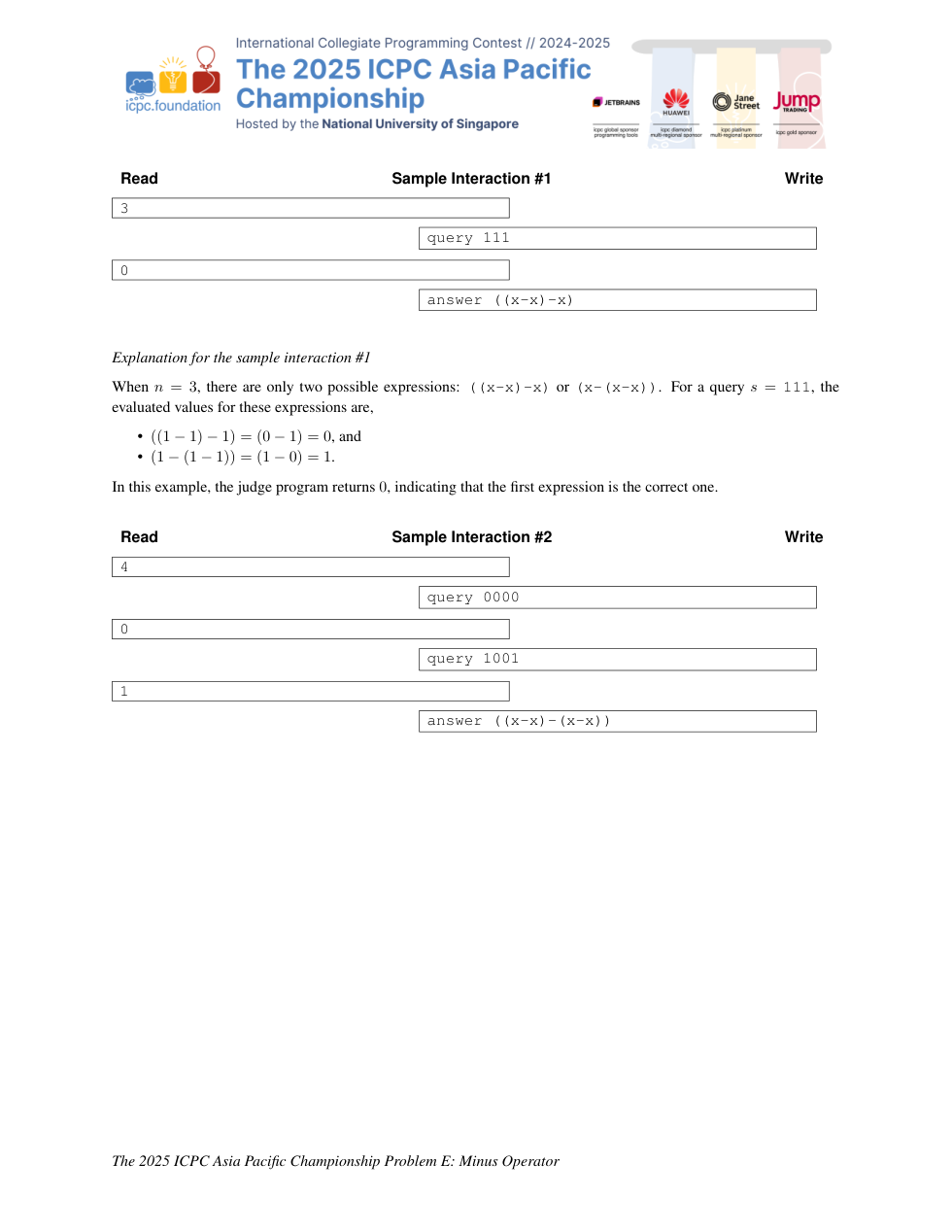
Read                         Sample Interaction #1                              Write

 3

                                  query 111

 0

                                  answer ((x-x)-x)


Explanation for the sample interaction #1

When n = 3, there are only two possible expressions: ((x-x)-x) or (x-(x-x)). For a query s = 111, the
evaluated values for these expressions are,

     • ((1 −1) −1) = (0 −1) = 0, and
     • (1 −(1 −1)) = (1 −0) = 1.

In this example, the judge program returns 0, indicating that the first expression is the correct one.


 Read                         Sample Interaction #2                              Write

 4

                                  query 0000

 0

                                  query 1001

 1

                                  answer ((x-x)-(x-x))


The 2025 ICPC Asia Pacific Championship Problem E: Minus Operator