以下页面来自赛事官方发布的原题PDF,已完整保存并渲染到本地。
可复制的 PDF 提取文本
ICPC 2024–2025, NERC – Northern Eurasia Finals
                        St. Petersburg, Novosibirsk, Astana, Tbilisi, December 15th, 2024
Problem B. BitBitJump

    Time limit:        3 seconds
    Memory limit:     1024 megabytes

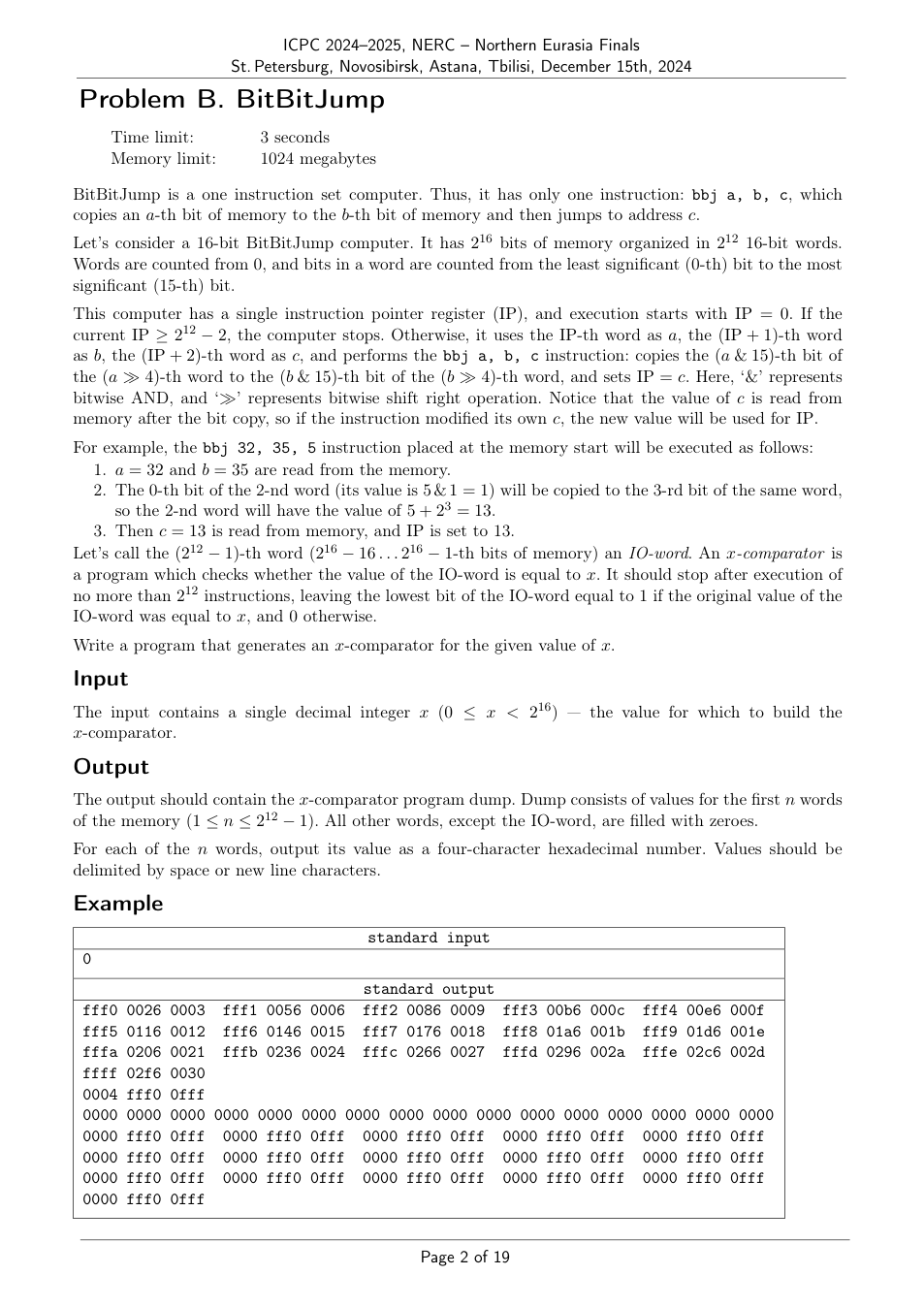
BitBitJump is a one instruction set computer. Thus, it has only one instruction: bbj a, b, c, which
copies an a-th bit of memory to the b-th bit of memory and then jumps to address c.
Let’s consider a 16-bit BitBitJump computer. It has 216 bits of memory organized in 212 16-bit words.
Words are counted from 0, and bits in a word are counted from the least significant (0-th) bit to the most
significant (15-th) bit.

This computer has a single instruction pointer register (IP), and execution starts with IP = 0. If the
current IP ≥212 −2, the computer stops. Otherwise, it uses the IP-th word as a, the (IP + 1)-th word
as b, the (IP + 2)-th word as c, and performs the bbj a, b, c instruction: copies the (a & 15)-th bit of
the (a ≫4)-th word to the (b & 15)-th bit of the (b ≫4)-th word, and sets IP = c. Here, ‘&’ represents
bitwise AND, and ‘≫’ represents bitwise shift right operation. Notice that the value of c is read from
memory after the bit copy, so if the instruction modified its own c, the new value will be used for IP.

For example, the bbj 32, 35, 5 instruction placed at the memory start will be executed as follows:
   1. a = 32 and b = 35 are read from the memory.
   2. The 0-th bit of the 2-nd word (its value is 5&1 = 1) will be copied to the 3-rd bit of the same word,
      so the 2-nd word will have the value of 5 + 23 = 13.
   3. Then c = 13 is read from memory, and IP is set to 13.
Let’s call the (212 −1)-th word (216 −16 . . . 216 −1-th bits of memory) an IO-word. An x-comparator is
a program which checks whether the value of the IO-word is equal to x. It should stop after execution of
no more than 212 instructions, leaving the lowest bit of the IO-word equal to 1 if the original value of the
IO-word was equal to x, and 0 otherwise.

Write a program that generates an x-comparator for the given value of x.

Input

The input contains a single decimal integer x (0 ≤x < 216) — the value for which to build the
x-comparator.

Output

The output should contain the x-comparator program dump. Dump consists of values for the first n words
of the memory (1 ≤n ≤212 −1). All other words, except the IO-word, are filled with zeroes.

For each of the n words, output its value as a four-character hexadecimal number. Values should be
delimited by space or new line characters.

Example

                                  standard input
 0

                                 standard output
 fff0 0026 0003  fff1 0056 0006  fff2 0086 0009  fff3 00b6 000c  fff4 00e6 000f
 fff5 0116 0012  fff6 0146 0015  fff7 0176 0018  fff8 01a6 001b  fff9 01d6 001e
 fffa 0206 0021  fffb 0236 0024  fffc 0266 0027  fffd 0296 002a  fffe 02c6 002d
 ffff 02f6 0030
 0004 fff0 0fff
 0000 0000 0000 0000 0000 0000 0000 0000 0000 0000 0000 0000 0000 0000 0000 0000
 0000 fff0 0fff  0000 fff0 0fff  0000 fff0 0fff  0000 fff0 0fff  0000 fff0 0fff
 0000 fff0 0fff  0000 fff0 0fff  0000 fff0 0fff  0000 fff0 0fff  0000 fff0 0fff
 0000 fff0 0fff  0000 fff0 0fff  0000 fff0 0fff  0000 fff0 0fff  0000 fff0 0fff
 0000 fff0 0fff


                                         Page 2 of 19

ICPC 2024–2025, NERC – Northern Eurasia Finals
                        St. Petersburg, Novosibirsk, Astana, Tbilisi, December 15th, 2024

Note

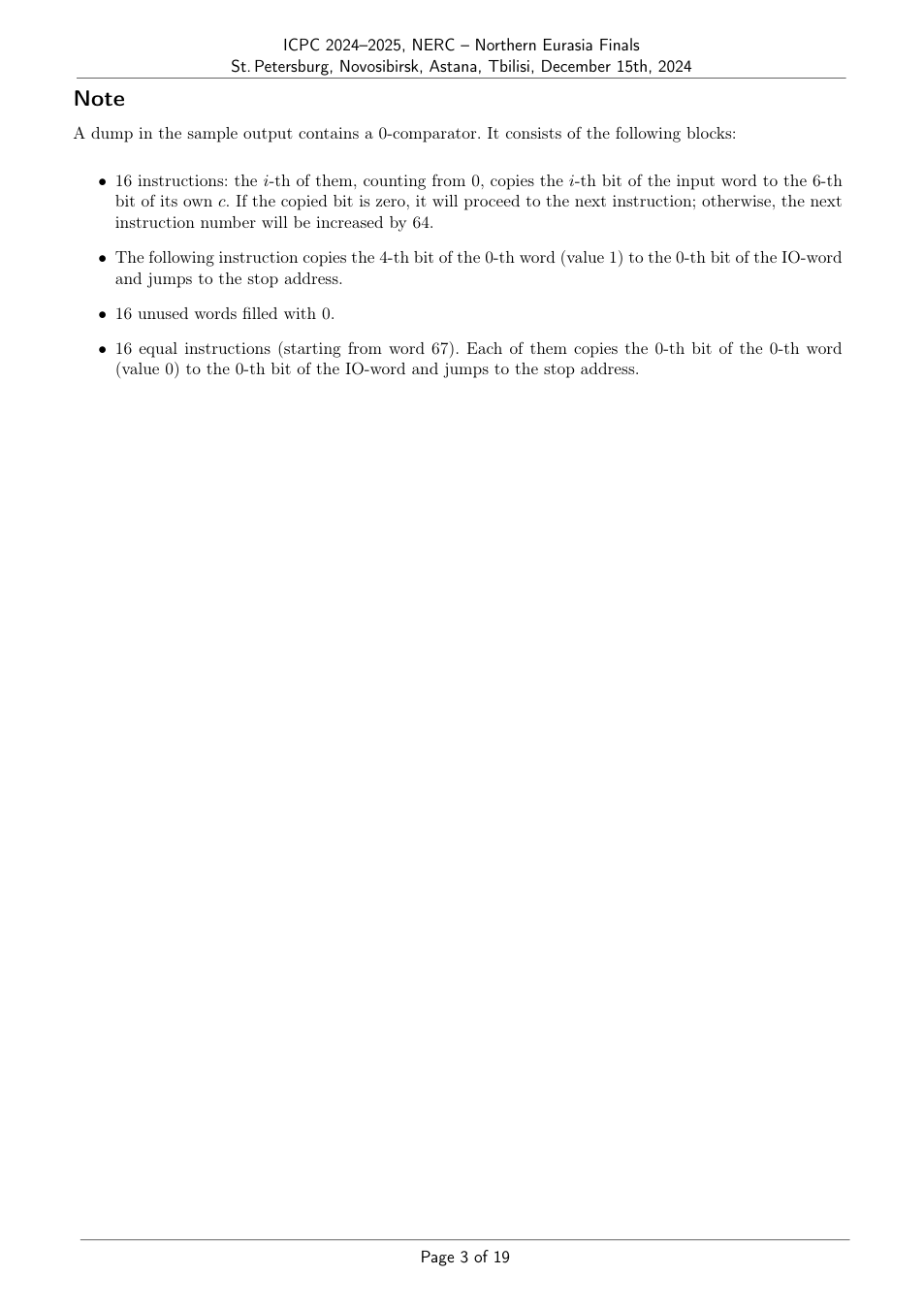
A dump in the sample output contains a 0-comparator. It consists of the following blocks:


   • 16 instructions: the i-th of them, counting from 0, copies the i-th bit of the input word to the 6-th
      bit of its own c. If the copied bit is zero, it will proceed to the next instruction; otherwise, the next
      instruction number will be increased by 64.

   • The following instruction copies the 4-th bit of the 0-th word (value 1) to the 0-th bit of the IO-word
     and jumps to the stop address.

   • 16 unused words filled with 0.

   • 16 equal instructions (starting from word 67). Each of them copies the 0-th bit of the 0-th word
      (value 0) to the 0-th bit of the IO-word and jumps to the stop address.


                                         Page 3 of 19