以下页面来自赛事官方发布的原题PDF,已完整保存并渲染到本地。
可复制的 PDF 提取文本
XVIII Open Olympiad in Informatics - Final Stage, Day 1 (Unrated, Online Mirror, IOI rules)
                                       Russia, Moscow, March, 8, 2024
Problem A. Draw Polygon Lines

     Input file:         standard input
    Output file:       standard output
    Time limit:        2 seconds
    Memory limit:     512 megabytes

This is an interactive problem.

You are given n points Ai = (xi, yi) on the plane. It is known that all xi are distinct and all yi are distinct.

Your task is to draw polygonal lines connecting these n points.

A polygonal line is defined by a permutation p1, p2, . . . , pn of numbers from 1 to n. The polygonal line
consists of n −1 segments, the first segment connects points Ap1 and Ap2, the second segment connects
points Ap2 and Ap3, . . ., the last segment connects points Apn−1 and Apn. Note that segments may intersect.
The sharpness of a polygonal line is defined as the number of indices 2 ≤i ≤n −1 such that the angle
∠Api−1ApiApi+1 is acute, i.e., strictly less than 90◦.

You need to solve four tasks:


   1. Find any polygonal line that has the maximum possible sharpness.

   2. Given an integer c. Find any polygonal line whose sharpness is ≤c.

   3. Given an integer c.

     Answer q queries, each specified by a single integer ki (c ≤ki ≤n −c). In the i-th query, you need
      to construct a polygonal line that has sharpness exactly ki.

   4. Given an integer c.
     For  each k from  c  to n −c,  construct a  polygonal  line  p(k)  with  sharpness  exactly  k.
     Provide n −2c + 1 numbers hash  p(c)  , hash  p(c+1)  , . . . , hash p(n−c)  as the answer, where
     hash(p) =  nP pibi−1  mod m is the polynomial hash of permutation p with parameters b = 106+3
                   i=1
     and m = 109 + 7.

    Then answer q queries, each specified by a single integer ki (c ≤ki ≤n −c). In the i-th query, you
     need to provide the polygonal line p(ki). It will be checked that the sharpness of this polygonal line
       is exactly ki and its hash matches the previously provided value hash  p(ki)  .

     Note that queries will appear after receiving the hashes.

Interaction Protocol

The first line contains two integers task, group (1 ≤task ≤4, 0 ≤group ≤21) — the number of the task
to be solved in this test and the test group number.

The second line contains a single integer n (3 ≤n ≤80 000) — the number of points on the plane.
Each of the next n lines contains two integers xi, yi (|xi|, |yi| ≤109) — the coordinates of the points. It
is guaranteed that all xi are distinct and all yi are distinct.

If task = 1, then the input ends here and you should output any permutation with the maximum possible
sharpness. The interaction ends here.
If task ̸= 1, then the next line contains a single integer c (2 ≤c ≤n ).                                                                           2
If task = 2, then the input ends here and you should output any permutation with sharpness ≤c. The
interaction ends here.
If task = 4, your solution should output n −2c + 1 integers hash  p(c)  , hash  p(c+1)  , . . . , hash p(n−c)  ,
where 0 ≤hash  p(i) < 109 + 7. Note that this should not be done if task = 3.


                                         Page 1 of 12

XVIII Open Olympiad in Informatics - Final Stage, Day 1 (Unrated, Online Mirror, IOI rules)
                                       Russia, Moscow, March, 8, 2024

Further interaction occurs only if task = 3 or task = 4.

The next line contains a single integer q (1 ≤q ≤50) — the number of queries.

Then q times, in each line, a query ki (c ≤ki ≤n −c) appears. As a response, you should output a
permutation on a separate line. The sharpness of this permutation should be exactly ki. If task = 4, the
hash of this permutation should match the previously provided hash.

Since this is an interactive problem, after outputting each line, do not forget to output a
newline character and flush the output buffer.

Scoring

The tests for this problem consist of twenty-one groups. Points for each group are given only if all tests
of the group and all tests of the required groups are passed.


                                        Constraints                       Required
  Group  Points                                                     Comment
                                                                  Groups                    task     n            c       Additional constraints

     0       0      –        –          –               –                –       Examples.

     1       8      1   n ≤20 000      –         xi < xi+1, yi < yi+1        –

     2       6      1    n ≤10        –         random points          –

     3       5      1    n ≤1000       –         random points          2

     4       5      1   n ≤20 000      –         random points        2 – 3

     5       6      1   n ≤20 000      –               –              1 – 4

     6      17     2   n = 80 000    c = 800             –                –

     7       7      3   n = 80 000    c = 800     xi < xi+1, yi < yi+1        –

     8       4      3    n = 50      c = 25       random points          –

     9       4      3    n = 200      c = 80       random points          –

    10      4      3    n = 1000     c = 300      random points          –

    11      3      3    n = 5000     c = 600      random points          –

    12      3      3   n = 80 000   c = 35 000     random points          –

    13      3      3   n = 80 000   c = 5000      random points         12

    14      3      3   n = 80 000   c = 2000            –             12 – 13

    15      2      3   n = 80 000    c = 800             –               7, 12 – 14

    16      6      4   n = 80 000    c = 800     xi < xi+1, yi < yi+1        –

    17      3      4    n = 5000     c = 600      random points          –

    18      3      4   n = 80 000   c = 35 000     random points          –

    19      3      4   n = 80 000   c = 5000      random points         18

    20      3      4   n = 80 000   c = 2000            –             18 – 19

    21      2      4   n = 80 000    c = 800             –             16, 18 – 20

In the groups where it is indicated that the points are random, all coordinates of all points xi, yi are
randomly generated with equal probability in the interval [−109, 109].


                                         Page 2 of 12

XVIII Open Olympiad in Informatics - Final Stage, Day 1 (Unrated, Online Mirror, IOI rules)
                                       Russia, Moscow, March, 8, 2024

Examples

             standard input                          standard output
 1 0
 4
 2 3
 1 8
 4 2
 0 0
                                         3 2 4 1

 2 0
 5
 -2 0
 -1 -1
 0 1
 2 -2
 3 -3
 2
                                         5 4 3 1 2

 3 0
 6
 0 0
 1 1
 2 2
 3 -3
 4 -2
 5 -1
 2
 3
 2
                                         1 2 3 4 5 6
 3
                                         4 5 6 1 3 2
 4
                                         6 2 4 3 5 1

 4 0
 5
 -2 -1
 -1 1
 1 6
 0 -3
 2 0
 2
                                         534735187 776162084
 2
 2
                                         4 5 1 2 3
 3
                                         1 3 2 5 4

Note

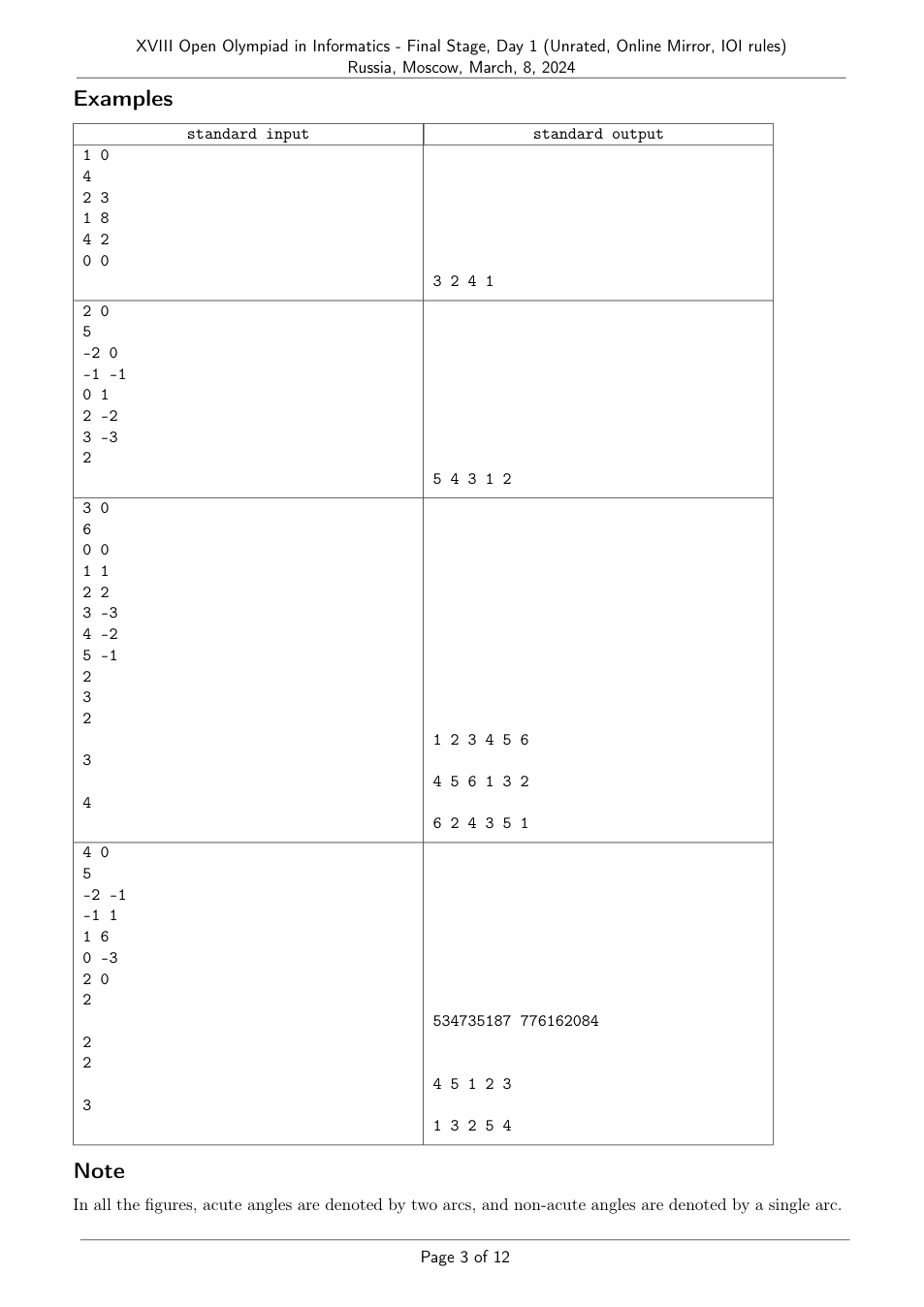
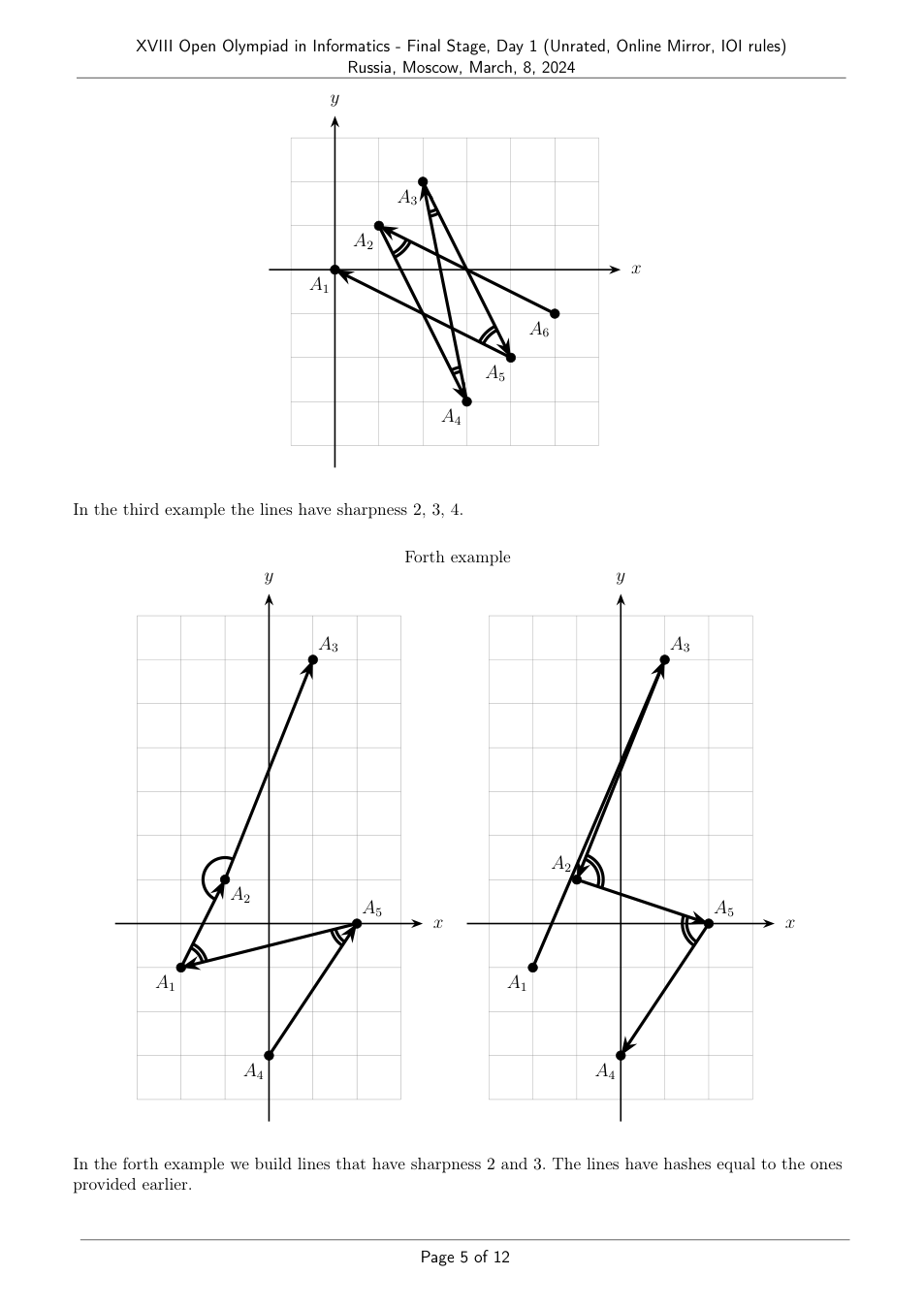
In all the figures, acute angles are denoted by two arcs, and non-acute angles are denoted by a single arc.


                                         Page 3 of 12

XVIII Open Olympiad in Informatics - Final Stage, Day 1 (Unrated, Online Mirror, IOI rules)
                                       Russia, Moscow, March, 8, 2024

                                         First and second examples
         y                                                 y


             A2                                     A4

                                         A1
                                                                       x


                                             A2

                                                          A2

                                                               A5
               A1


                       A3


                                 x
         A4


In the first example all angles are sharp, so the line has maximum sharpness 2.

In the second sample the sharpness equals to 1, it is ≤2.


                                       Third example
        y                                         y


                 A3                                   A3

         A2                                   A2

                                   x
                                                                        x
     A1                                   A1
                              A6                                   A6

                      A5                                   A5


                  A4                                   A4


                                         Page 4 of 12

XVIII Open Olympiad in Informatics - Final Stage, Day 1 (Unrated, Online Mirror, IOI rules)
                                       Russia, Moscow, March, 8, 2024

                             y


                                A3

                            A2
                                                      x
                       A1

                                             A6

                                         A5

                                    A4


In the third example the lines have sharpness 2, 3, 4.


                                         Forth example
                      y                                       y


                        A3                                 A3


                                               A2

                A2
                             A5                                 A5
                                   x                                 x


        A1                                 A1


                 A4                                 A4


In the forth example we build lines that have sharpness 2 and 3. The lines have hashes equal to the ones
provided earlier.


                                         Page 5 of 12