以下页面来自赛事官方发布的原题PDF,已完整保存并渲染到本地。
可复制的 PDF 提取文本
ICPC 2020–2021, NERC – Northern Eurasia Finals, Onsite
                              St. Petersburg, Minsk, Tbilisi, Riga – April 4th, 2021
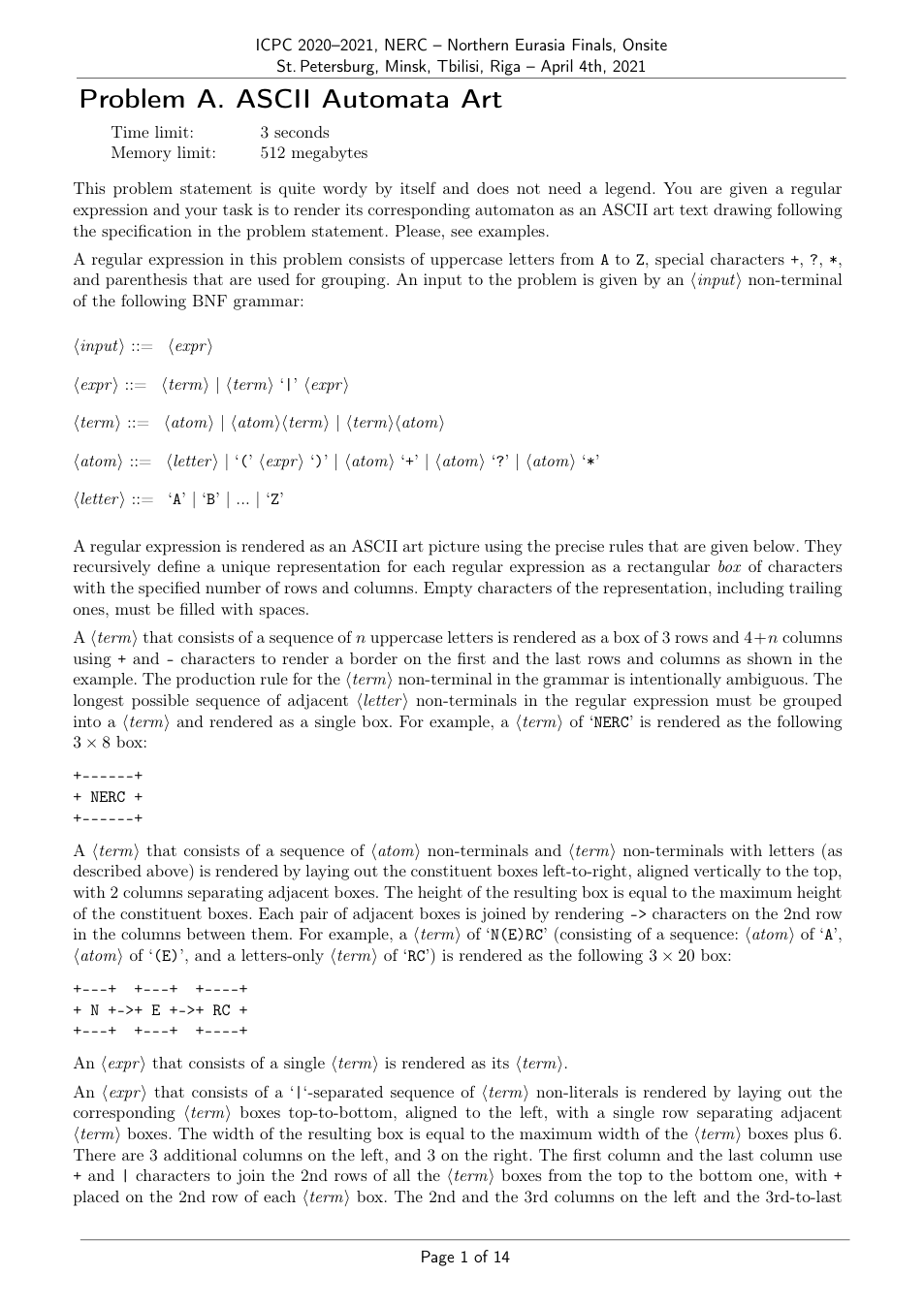
Problem A. ASCII Automata Art

    Time limit:        3 seconds
    Memory limit:     512 megabytes

This problem statement is quite wordy by itself and does not need a legend. You are given a regular
expression and your task is to render its corresponding automaton as an ASCII art text drawing following
the specification in the problem statement. Please, see examples.

A regular expression in this problem consists of uppercase letters from A to Z, special characters +, ?, *,
and parenthesis that are used for grouping. An input to the problem is given by an ⟨input⟩non-terminal
of the following BNF grammar:

⟨input⟩::=  ⟨expr⟩
⟨expr⟩::=  ⟨term⟩| ⟨term⟩‘|’ ⟨expr⟩
⟨term⟩::=  ⟨atom⟩| ⟨atom⟩⟨term⟩| ⟨term⟩⟨atom⟩
⟨atom⟩::=  ⟨letter⟩| ‘(’ ⟨expr⟩‘)’ | ⟨atom⟩‘+’ | ⟨atom⟩‘?’ | ⟨atom⟩‘*’
⟨letter⟩::=  ‘A’ | ‘B’ | ... | ‘Z’

A regular expression is rendered as an ASCII art picture using the precise rules that are given below. They
recursively define a unique representation for each regular expression as a rectangular box of characters
with the specified number of rows and columns. Empty characters of the representation, including trailing
ones, must be filled with spaces.
A ⟨term⟩that consists of a sequence of n uppercase letters is rendered as a box of 3 rows and 4+n columns
using + and - characters to render a border on the first and the last rows and columns as shown in the
example. The production rule for the ⟨term⟩non-terminal in the grammar is intentionally ambiguous. The
longest possible sequence of adjacent ⟨letter⟩non-terminals in the regular expression must be grouped
into a ⟨term⟩and rendered as a single box. For example, a ⟨term⟩of ‘NERC’ is rendered as the following
3 × 8 box:
+------+
+ NERC +
+------+

A ⟨term⟩that consists of a sequence of ⟨atom⟩non-terminals and ⟨term⟩non-terminals with letters (as
described above) is rendered by laying out the constituent boxes left-to-right, aligned vertically to the top,
with 2 columns separating adjacent boxes. The height of the resulting box is equal to the maximum height
of the constituent boxes. Each pair of adjacent boxes is joined by rendering -> characters on the 2nd row
in the columns between them. For example, a ⟨term⟩of ‘N(E)RC’ (consisting of a sequence: ⟨atom⟩of ‘A’,
⟨atom⟩of ‘(E)’, and a letters-only ⟨term⟩of ‘RC’) is rendered as the following 3 × 20 box:
+---+  +---+  +----+
+ N +->+ E +->+ RC +
+---+  +---+  +----+

An ⟨expr⟩that consists of a single ⟨term⟩is rendered as its ⟨term⟩.
An ⟨expr⟩that consists of a ‘|‘-separated sequence of ⟨term⟩non-literals is rendered by laying out the
corresponding ⟨term⟩boxes top-to-bottom, aligned to the left, with a single row separating adjacent
⟨term⟩boxes. The width of the resulting box is equal to the maximum width of the ⟨term⟩boxes plus 6.
There are 3 additional columns on the left, and 3 on the right. The first column and the last column use
+ and | characters to join the 2nd rows of all the ⟨term⟩boxes from the top to the bottom one, with +
placed on the 2nd row of each ⟨term⟩box. The 2nd and the 3rd columns on the left and the 3rd-to-last


                                         Page 1 of 14

ICPC 2020–2021, NERC – Northern Eurasia Finals, Onsite
                              St. Petersburg, Minsk, Tbilisi, Riga – April 4th, 2021

and the 2nd-to-last columns on the right have -> characters on the 2nd rows of the corresponding ⟨term⟩
boxes. Additionally, shorter ⟨term⟩boxes are connected on the right with extra - characters on their 2nd
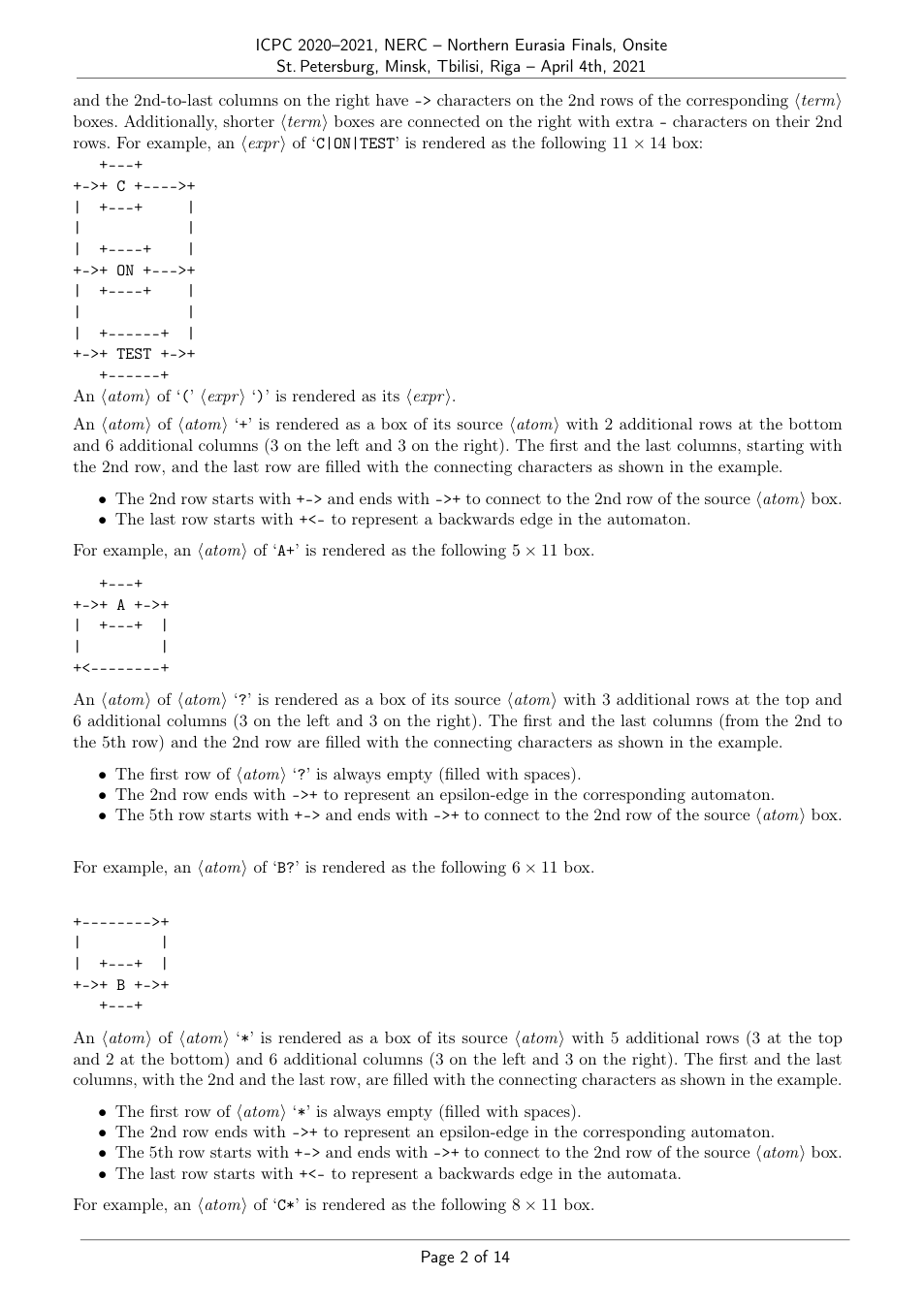
rows. For example, an ⟨expr⟩of ‘C|ON|TEST’ is rendered as the following 11 × 14 box:
   +---+
+->+ C +---->+
|  +---+     |
|            |
|  +----+    |
+->+ ON +--->+
|  +----+    |
|            |
|  +------+  |
+->+ TEST +->+
   +------+
An ⟨atom⟩of ‘(’ ⟨expr⟩‘)’ is rendered as its ⟨expr⟩.
An ⟨atom⟩of ⟨atom⟩‘+’ is rendered as a box of its source ⟨atom⟩with 2 additional rows at the bottom
and 6 additional columns (3 on the left and 3 on the right). The first and the last columns, starting with
the 2nd row, and the last row are filled with the connecting characters as shown in the example.

   • The 2nd row starts with +-> and ends with ->+ to connect to the 2nd row of the source ⟨atom⟩box.
   • The last row starts with +<- to represent a backwards edge in the automaton.
For example, an ⟨atom⟩of ‘A+’ is rendered as the following 5 × 11 box.
   +---+
+->+ A +->+
|  +---+  |
|         |
+<--------+

An ⟨atom⟩of ⟨atom⟩‘?’ is rendered as a box of its source ⟨atom⟩with 3 additional rows at the top and
6 additional columns (3 on the left and 3 on the right). The first and the last columns (from the 2nd to
the 5th row) and the 2nd row are filled with the connecting characters as shown in the example.

   • The first row of ⟨atom⟩‘?’ is always empty (filled with spaces).
   • The 2nd row ends with ->+ to represent an epsilon-edge in the corresponding automaton.
   • The 5th row starts with +-> and ends with ->+ to connect to the 2nd row of the source ⟨atom⟩box.

For example, an ⟨atom⟩of ‘B?’ is rendered as the following 6 × 11 box.

+-------->+
|         |
|  +---+  |
+->+ B +->+
   +---+

An ⟨atom⟩of ⟨atom⟩‘*’ is rendered as a box of its source ⟨atom⟩with 5 additional rows (3 at the top
and 2 at the bottom) and 6 additional columns (3 on the left and 3 on the right). The first and the last
columns, with the 2nd and the last row, are filled with the connecting characters as shown in the example.

   • The first row of ⟨atom⟩‘*’ is always empty (filled with spaces).
   • The 2nd row ends with ->+ to represent an epsilon-edge in the corresponding automaton.
   • The 5th row starts with +-> and ends with ->+ to connect to the 2nd row of the source ⟨atom⟩box.
   • The last row starts with +<- to represent a backwards edge in the automata.
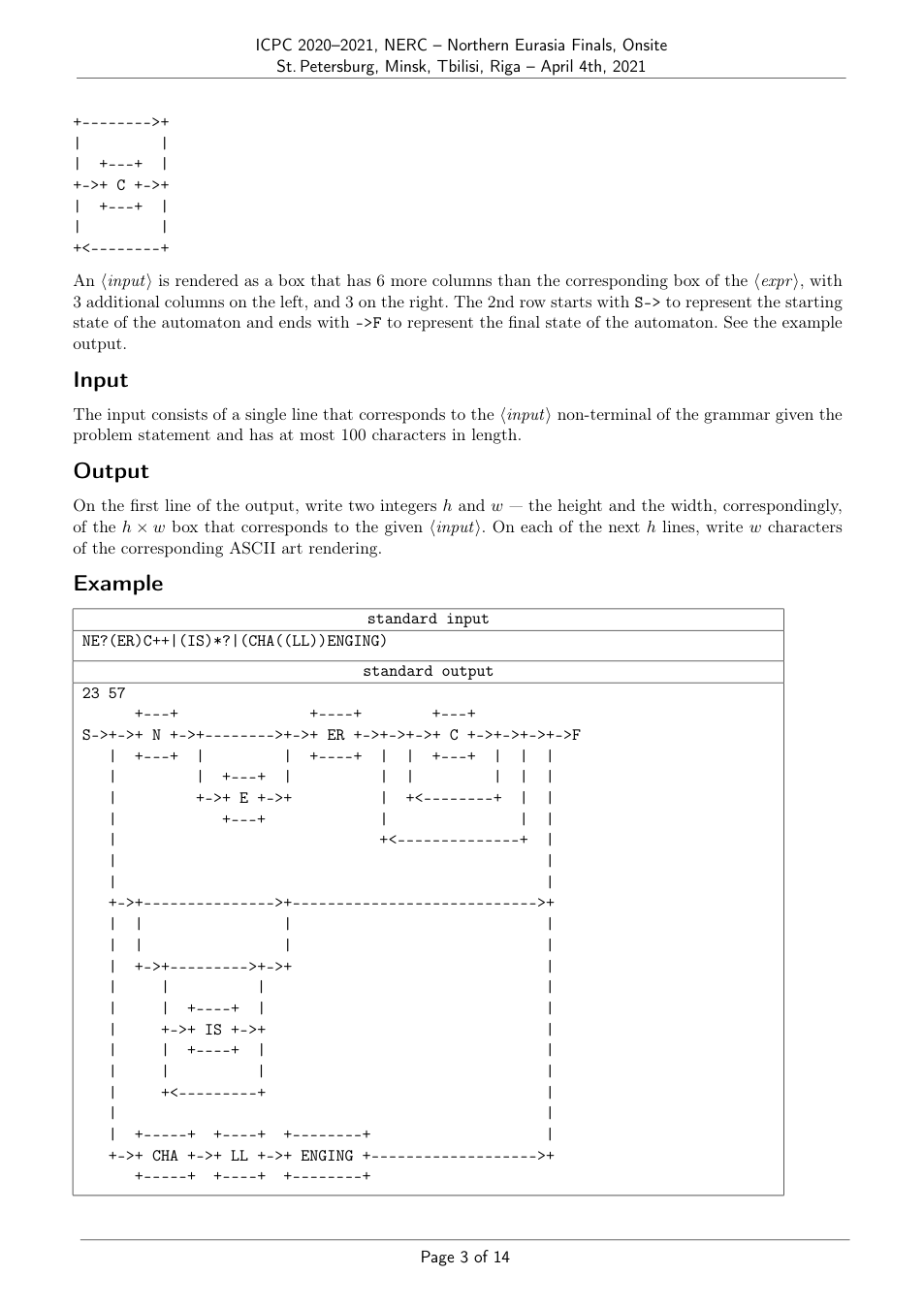
For example, an ⟨atom⟩of ‘C*’ is rendered as the following 8 × 11 box.

                                         Page 2 of 14

ICPC 2020–2021, NERC – Northern Eurasia Finals, Onsite
                              St. Petersburg, Minsk, Tbilisi, Riga – April 4th, 2021


+-------->+
|         |
|  +---+  |
+->+ C +->+
|  +---+  |
|         |
+<--------+

An ⟨input⟩is rendered as a box that has 6 more columns than the corresponding box of the ⟨expr⟩, with
3 additional columns on the left, and 3 on the right. The 2nd row starts with S-> to represent the starting
state of the automaton and ends with ->F to represent the final state of the automaton. See the example
output.

Input

The input consists of a single line that corresponds to the ⟨input⟩non-terminal of the grammar given the
problem statement and has at most 100 characters in length.

Output

On the first line of the output, write two integers h and w — the height and the width, correspondingly,
of the h × w box that corresponds to the given ⟨input⟩. On each of the next h lines, write w characters
of the corresponding ASCII art rendering.

Example

                                  standard input
 NE?(ER)C++|(IS)*?|(CHA((LL))ENGING)

                                 standard output
 23 57
       +---+               +----+        +---+
 S->+->+ N +->+-------->+->+ ER +->+->+->+ C +->+->+->+->F
    |  +---+  |         |  +----+  |  |  +---+  |  |  |
    |         |  +---+  |          |  |         |  |  |
    |         +->+ E +->+          |  +<--------+  |  |
    |            +---+             |               |  |
    |                              +<--------------+  |
    |                                                 |
    |                                                 |
    +->+--------------->+---------------------------->+
    |  |                |                             |
    |  |                |                             |
    |  +->+--------->+->+                             |
    |     |          |                                |
    |     |  +----+  |                                |
    |     +->+ IS +->+                                |
    |     |  +----+  |                                |
    |     |          |                                |
    |     +<---------+                                |
    |                                                 |
    |  +-----+  +----+  +--------+                    |
    +->+ CHA +->+ LL +->+ ENGING +------------------->+
       +-----+  +----+  +--------+


                                         Page 3 of 14