以下页面来自赛事官方发布的原题PDF,已完整保存并渲染到本地。
可复制的 PDF 提取文本
XIX Russia Team Open, High School Programming Contest
              St Petersburg, Barnaul, Tbilisi, Almaty, Kremenchug, Sochi, December 9, 2018
Problem B. LaTeX Expert

    Time limit:        1 second
    Memory limit:     512 megabytes

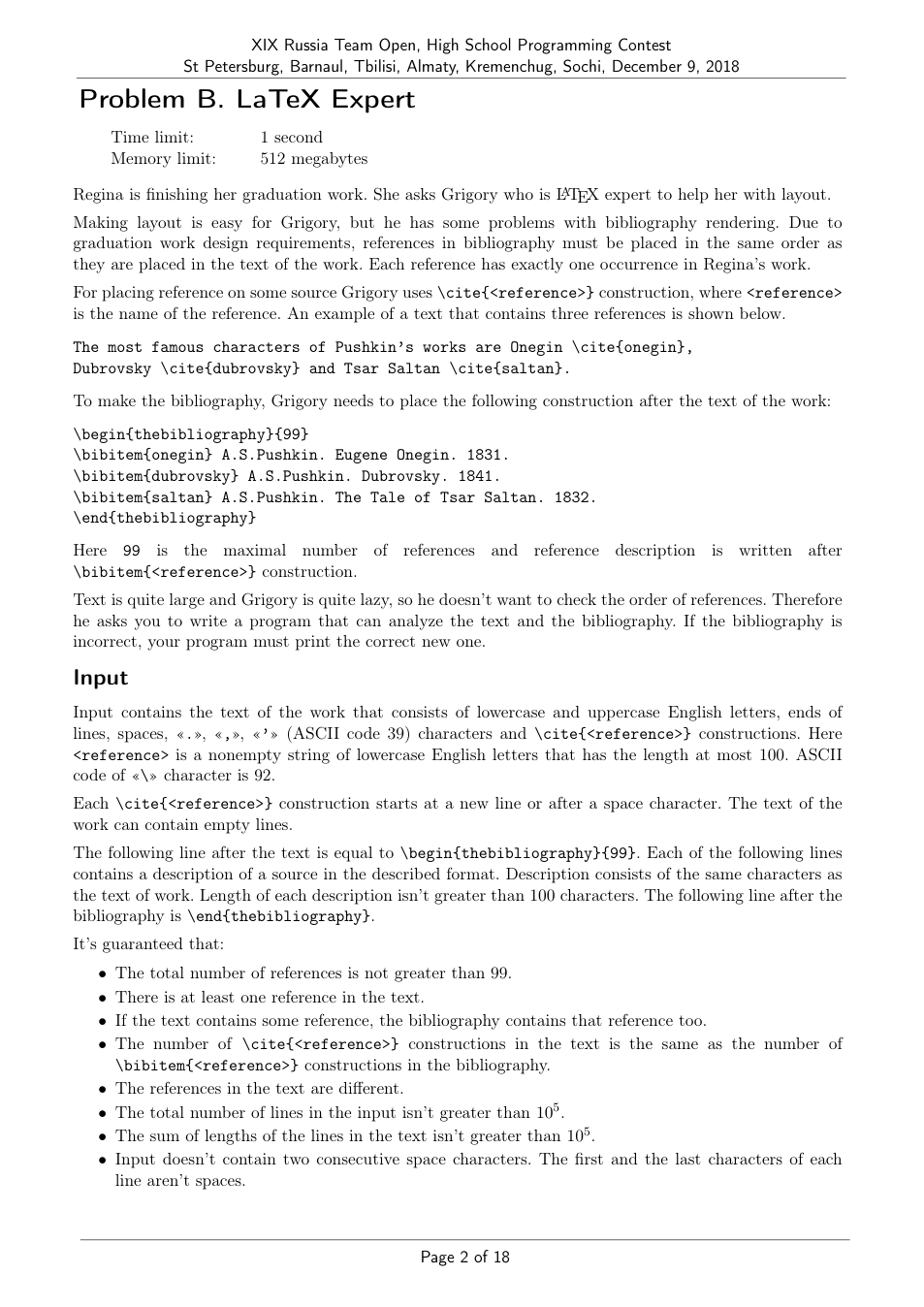
Regina is finishing her graduation work. She asks Grigory who is LATEX expert to help her with layout.
Making layout  is easy for Grigory, but he has some problems with bibliography rendering. Due to
graduation work design requirements, references in bibliography must be placed in the same order as
they are placed in the text of the work. Each reference has exactly one occurrence in Regina’s work.

For placing reference on some source Grigory uses \cite{<reference>} construction, where <reference>
is the name of the reference. An example of a text that contains three references is shown below.

The most famous characters of Pushkin’s works are Onegin \cite{onegin},
Dubrovsky \cite{dubrovsky} and Tsar Saltan \cite{saltan}.

To make the bibliography, Grigory needs to place the following construction after the text of the work:

\begin{thebibliography}{99}
\bibitem{onegin} A.S.Pushkin. Eugene Onegin. 1831.
\bibitem{dubrovsky} A.S.Pushkin. Dubrovsky. 1841.
\bibitem{saltan} A.S.Pushkin. The Tale of Tsar Saltan. 1832.
\end{thebibliography}

Here  99   is  the  maximal  number  of  references  and  reference  description   is  written  after
\bibitem{<reference>} construction.

Text is quite large and Grigory is quite lazy, so he doesn’t want to check the order of references. Therefore
he asks you to write a program that can analyze the text and the bibliography. If the bibliography is
incorrect, your program must print the correct new one.

Input

Input contains the text of the work that consists of lowercase and uppercase English letters, ends of
lines, spaces, «.», «,», «’» (ASCII code 39) characters and \cite{<reference>} constructions. Here
<reference> is a nonempty string of lowercase English letters that has the length at most 100. ASCII
code of «\» character is 92.

Each \cite{<reference>} construction starts at a new line or after a space character. The text of the
work can contain empty lines.

The following line after the text is equal to \begin{thebibliography}{99}. Each of the following lines
contains a description of a source in the described format. Description consists of the same characters as
the text of work. Length of each description isn’t greater than 100 characters. The following line after the
bibliography is \end{thebibliography}.

It’s guaranteed that:

   • The total number of references is not greater than 99.
   • There is at least one reference in the text.
   •  If the text contains some reference, the bibliography contains that reference too.
   • The number of \cite{<reference>} constructions in the text  is the same as the number of
     \bibitem{<reference>} constructions in the bibliography.
   • The references in the text are different.
   • The total number of lines in the input isn’t greater than 105.
   • The sum of lengths of the lines in the text isn’t greater than 105.
   • Input doesn’t contain two consecutive space characters. The first and the last characters of each
      line aren’t spaces.


                                         Page 2 of 18

XIX Russia Team Open, High School Programming Contest
              St Petersburg, Barnaul, Tbilisi, Almaty, Kremenchug, Sochi, December 9, 2018

Output

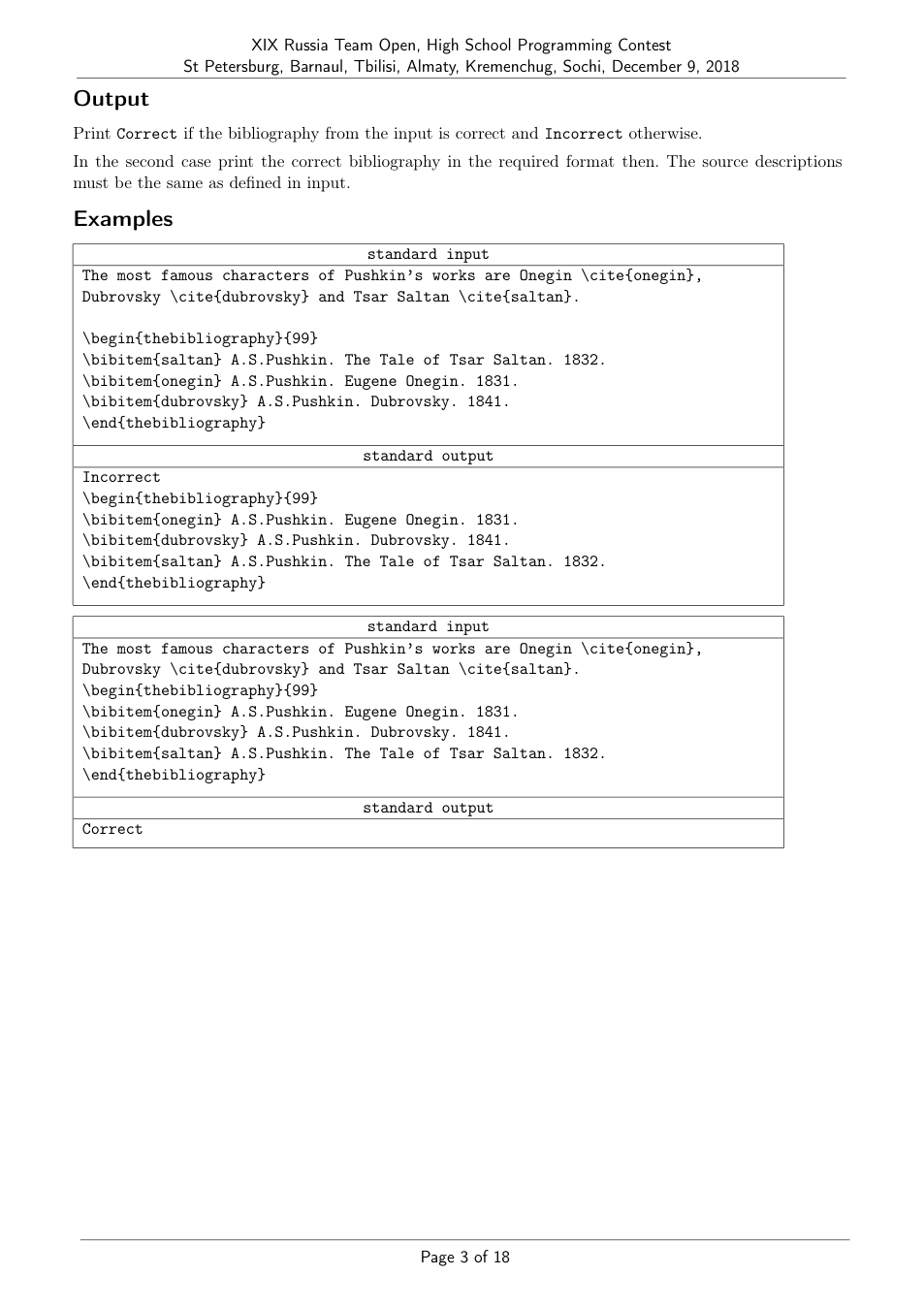
Print Correct if the bibliography from the input is correct and Incorrect otherwise.

In the second case print the correct bibliography in the required format then. The source descriptions
must be the same as defined in input.

Examples

                                  standard input
 The most famous characters of Pushkin’s works are Onegin \cite{onegin},
 Dubrovsky \cite{dubrovsky} and Tsar Saltan \cite{saltan}.

 \begin{thebibliography}{99}
 \bibitem{saltan} A.S.Pushkin. The Tale of Tsar Saltan. 1832.
 \bibitem{onegin} A.S.Pushkin. Eugene Onegin. 1831.
 \bibitem{dubrovsky} A.S.Pushkin. Dubrovsky. 1841.
 \end{thebibliography}

                                 standard output
 Incorrect
 \begin{thebibliography}{99}
 \bibitem{onegin} A.S.Pushkin. Eugene Onegin. 1831.
 \bibitem{dubrovsky} A.S.Pushkin. Dubrovsky. 1841.
 \bibitem{saltan} A.S.Pushkin. The Tale of Tsar Saltan. 1832.
 \end{thebibliography}


                                  standard input
 The most famous characters of Pushkin’s works are Onegin \cite{onegin},
 Dubrovsky \cite{dubrovsky} and Tsar Saltan \cite{saltan}.
 \begin{thebibliography}{99}
 \bibitem{onegin} A.S.Pushkin. Eugene Onegin. 1831.
 \bibitem{dubrovsky} A.S.Pushkin. Dubrovsky. 1841.
 \bibitem{saltan} A.S.Pushkin. The Tale of Tsar Saltan. 1832.
 \end{thebibliography}

                                 standard output
 Correct


                                         Page 3 of 18